

When our daughter became more involved in music many years ago, I purchased a small recording kit so that I could record her and the various groups she performed with. A few years ago, she escaped the coop for learning and for love and moved well out of recording distance, so the equipment sat unused in a drawer.
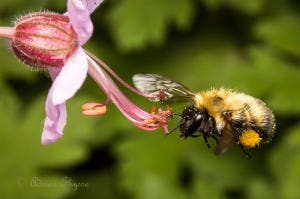
During the COVID lockdown, I developed an interest in cycling off-road, and the idea of using a mountain bike as a means of exploring nature again. As I explained in a previous post, the idea of nature trail cycling was to get me back into exploring nature and photography, but after a few trips I realized I was missing out on capturing another sense that was often very pleasingly stimulated: my sense of hearing. Listening to the dawn chorus, geese on the pond, the buzz of bees and the howling and yipping of coyotes, and the background sounds of nature were not represented well in my first video recording efforts.
Last year I began carrying recording equipment along with me. I did some tentative recordings with the old Rode NTG-1 shotgun microphone and disintegrating Zoom H4n recorder or by using the same microphone with my cell phone and a XLR adapter. I found that even with this basic equipment I could at times get some interesting results.
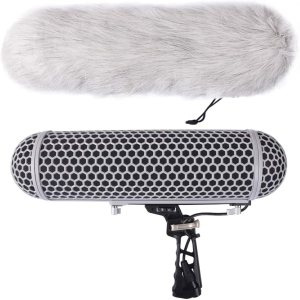
However, I found that when recording outdoors in a natural area, wind was a regular barrier to clean audio, as you can hear in the above example. While the rustle of leaves is expected, the rumbling distortion caused by air pressure disturbing the microphone diaphragm is not. The solution? The first line of defense is a furry cover, also known as a deadcat (or in Australia, a dead wombat) that pulls over a foam windscreen on the head of the microphone. These work well for light breezes, but they are totally inadequate when it comes to wind. The solution for wind noise lies in a cover that isolates the microphone from air pressure without isolating it from sound waves: this cover is called a blimp or zeppelin. I found a second-hand Micolive Microphone Windshield through Amazon Warehouse which I hope to put to use early this spring.
In the process of learning how to improve field recording techniques, I entered a vortex of information on sound, audio recorders and microphones. I’ve learned about SASS, ASMR, ORTF; I delved into Blumlein arrangements, Jecklin disks, and binaural heads; I read about ambisonics, ambience, and foley; I explored sound design, soundscapes, and acoustic ecology, including anthrophony, biophony, geophony and sheer bloody irritating noise…
However, to make a long story short, one of the foremost discoveries I found out about is that microphones with the high sensitivity and low self-noise I require can actually be made at home for a fraction of the cost of commercially available microphones. I have made some of these, and I am working on others, including a stereo ambient sampling system (SASS ) unit and hydrophones.
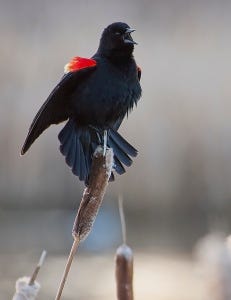
With these homemade gadgets, old devices, and some updated equipment (including a small Zoom F3 field recorder) I’m now in a position to record a greater variety of natural sounds, from scurrying ants to bugling of rutting elk; from fluttering birds to rolling thunderstorms; and even underwater and ambient soundscapes. I’ll be ready for Spring and the return of serenading birds, fluid lakes, bursting buds, and a whole lot of burgeoning greenness. From now on, when I’m exploring local natural areas (and if the Deity of Enthusiasm doesn’t abandon me) there will also be a lot of audio recordings going on.
To what end, you may ask?
You may ask.