
Happy Coelacanth Day!
The first "living fossil".

As a child, our family lived for a few years (mid-1970s) in East London on the coast of South Africa. East London’s claim to fame was the discovery of the Coelacanth, a lobe-finned fish that had previously been known only in the fossil record. The first coelacanth (below) is still on display at the East London Museum, which I would often visit during my lunch break at the nearby Selborne College.
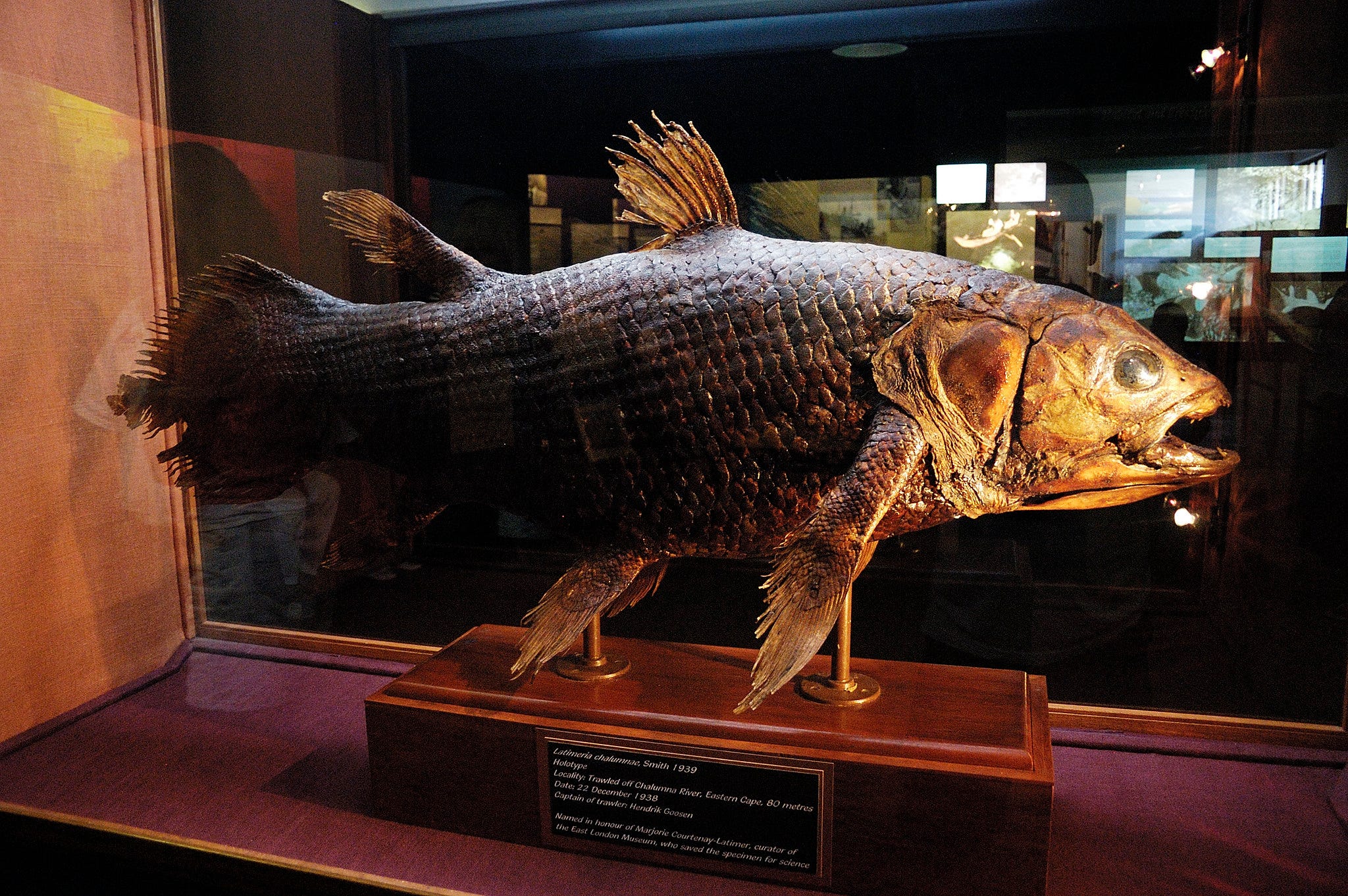
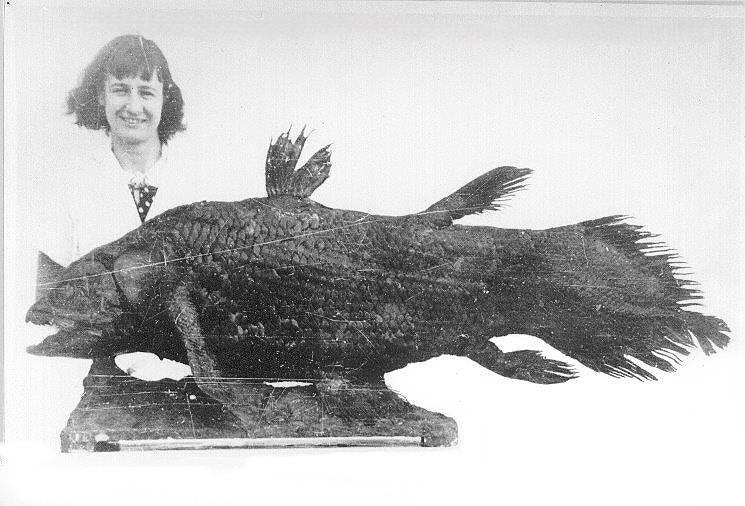
This fish was caught on the 22nd of December, 1938, by Captain Hendrik Goosen, who had been trawling off the Chalumna River near East London. By previous agreement, he had called in Marjorie Courtenay-Latimer, the curator of the East London Museum, to examine his catch. Amoung the fish he had netted, she noticed “the most beautiful fish I had ever seen, five feet long, and a pale mauve blue with iridescent silver markings.” She had no training in ichthyology and could find no record of the fish in her collection of books, so she sent a letter and a rough sketch to a friend, Dr J.B.L. Smith, a chemistry professor at Rhodes University, Grahamstown.
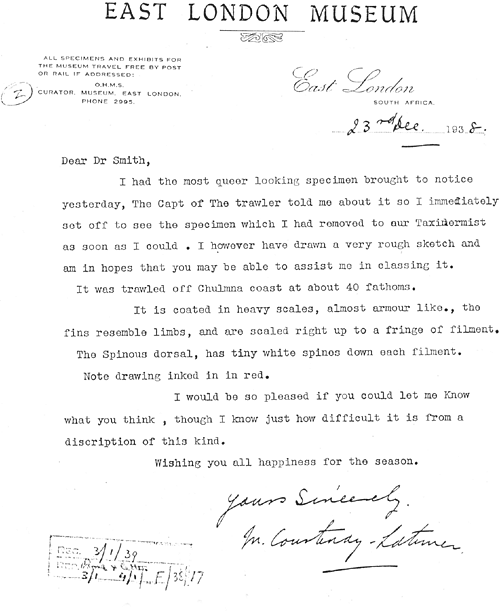
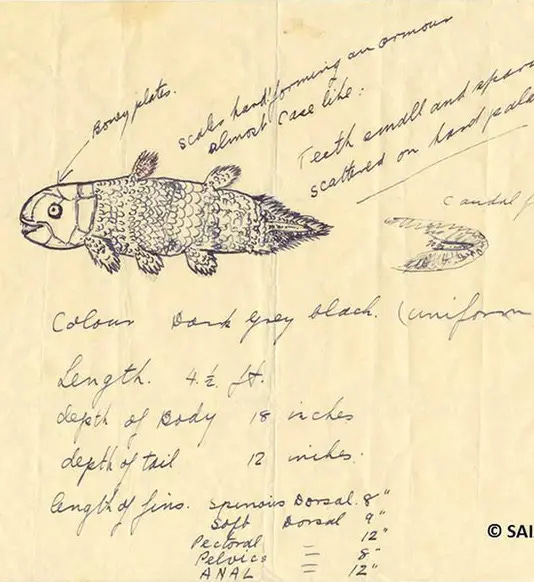
Smith had a known penchant for ichthyology; however, he was on Christmas holidays at the time, so he did not find out about the discovery until later. In the meantime, not having other means of preservation, Latimer had sent the fish to a taxidermist to be mounted - only to receive an urgent cable from Smith on the 3 of January: “MOST IMPORTANT PRESERVE SKELETON AND GILLS = FISH DESCRIBED.” It was too late - the innards had been discarded and could not be found, despite a search through the garbage. He finally arrived to view the specimen on February 16, 1939, and he named it Latimeria chalumnae in honour of Marjorie Courtenay-Latimer and the river near where it was found. It was to be 14 years before J.B.L. Smith obtained another fully intact specimen.

For more on the history of the Coelacanth, as well as a video of a living one in its habitat, see Dinofish.
For more on South African aquatic life, visit SAIAB (founded by J.B.L. Smith`s widow, Margaret Mary Smith, who persuaded Rhodes University and the Council for Scientific and Industrial Research to establish the JLB Smith Institute of Ichthyology in 1968).
For those with money or academic access, go to J.B.L. Smith`s description of the first fish in Nature (Nature 143, 748-750 (6 May 1939) | doi:10.1038/143748a0)
This post is an adapted republication from my now-shuttered blog, A Natural Selection. (22 December 2008)